You've seen them. You search something, and before the usual list of links, Google writes you a paragraph with a few small links tucked inside it. That's an AI Overview.
For a business, there are really two questions. How often does it happen? And how do you become one of those little links?
How often it happens (and when)
Pew Research Center tracked the real Google searches of 900 U.S. adults in March 2025. Here's what they found:
- 18% of searches produced an AI summary.
- 88% of those summaries cited three or more sources.
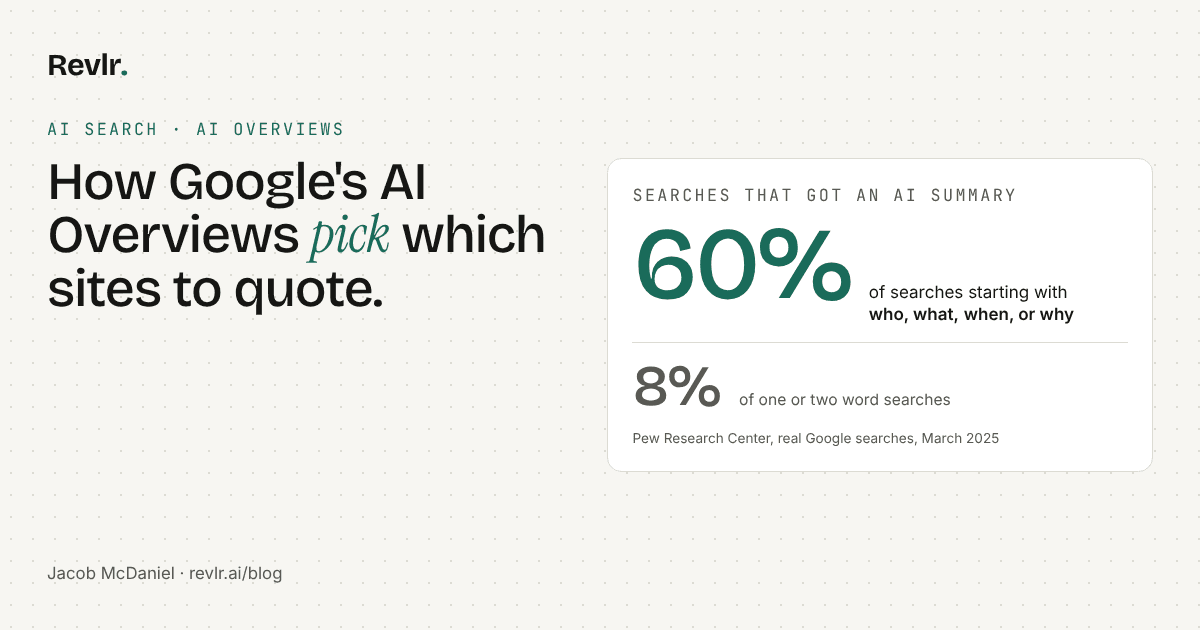
- Questions triggered them most. Searches starting with "who," "what," "when," or "why" got an AI summary 60% of the time.
- Longer searches did too. Searches of 10 words or more got one 53% of the time. One- or two-word searches: just 8%.
That last part matters. AI Overviews show up most for the exact kind of searches your customers type when they're trying to figure something out: full questions, in their own words.
Why it matters
In the same study, people clicked a regular search result on 8% of visits when an AI summary appeared, compared with 15% when one didn't. They clicked a link inside the summary itself only about 1% of the time.
Read that twice. When an AI Overview shows up, fewer people click anything. If you're one of the sources named in the summary, at least your name is in the answer. If you're not, you might not get seen at all.
How Google picks the sources
Google has said more about this than most people realize. From its own documentation on AI features:
It runs more than one search. Google says AI Overviews and AI Mode may use a technique called "query fan-out," running several related searches across subtopics to put the answer together. That means your page can be picked for a sub-question you never targeted directly, and it means covering a topic thoroughly pays off.
The page has to be eligible. To be shown as a supporting link, a page must be indexed and eligible to show a snippet in Google Search. Google says there are "no additional technical requirements."
There's no secret markup. Google says there's no special optimization or schema needed for AI Overviews. Its advice is regular, good SEO: let Google crawl you, link your pages together, keep important content in text, and make sure any structured data matches what's on the page.
It doesn't always show up. Google says AI Overviews appear only when its systems think they add something beyond the regular results. That's why some of your searches get one and some don't.
What tends to get quoted
Pew also looked at which sites AI summaries link to most. Wikipedia, YouTube, and Reddit were the most common in both AI summaries and regular results, making up 15% of AI summary sources. Government sites got noticeably more love in AI summaries: 6% of sources, compared with 2% in regular results.
The pattern: pages that are clear, specific, and trusted. You don't need to be Wikipedia. You do need to answer the question better than the next page does.
What you can do this week
- Make sure your pages can be quoted. Check that nothing on your key pages says
nosnippetormax-snippet:0. These tags tell Google not to quote you, which keeps you out of AI Overviews. - Answer questions the way people ask them. Use headings that match real customer questions, and put a clear, direct answer in the first sentence or two under each one.
- Cover the whole topic. Because of query fan-out, a set of pages that answer the related questions around your service beats one page trying to do everything.
- Be specific. Prices, timeframes, numbers, and named examples give Google something concrete to quote.
- Keep doing the SEO basics. AI Overviews run on regular Google Search. If you don't rank, you won't be picked.
How Revlr checks this
Revlr's AEO score looks at exactly this kind of thing: question-shaped headings, clear answers near the top, lists and tables Google can lift, and whether your snippet settings let you be quoted at all. Your free scan includes it.
See everything we check on the AI search check page.
Questions
Google says AI Overviews may run several related searches, called query fan-out, and link pages that support the answer. A page must be indexed and eligible to show a snippet. Google says no special markup is needed.
In Pew Research Center's 2025 study of real Google searches, 18% produced an AI summary. Questions and longer searches triggered them far more often.
Yes. Google says you can use nosnippet, data-nosnippet, or max-snippet to limit what's shown from your pages, or noindex to keep a page out of Search entirely.
No. Google says there's no special markup or optimization required. Structured data is still useful for regular search results.
Sources
Find out if Google can quote you.
A free Revlr scan checks your AEO readiness and snippet settings.
Scan my site