If you've Googled "how to get cited by ChatGPT" lately, you've met the checklist. Add an llms.txt file. Chunk your content. Add AI schema. Do all three by Friday or get left behind.
Some of it works. A lot of it doesn't. And the stuff that works best is less exciting than the stuff being sold.
Here's what the evidence actually says.
What works
1. Being reachable
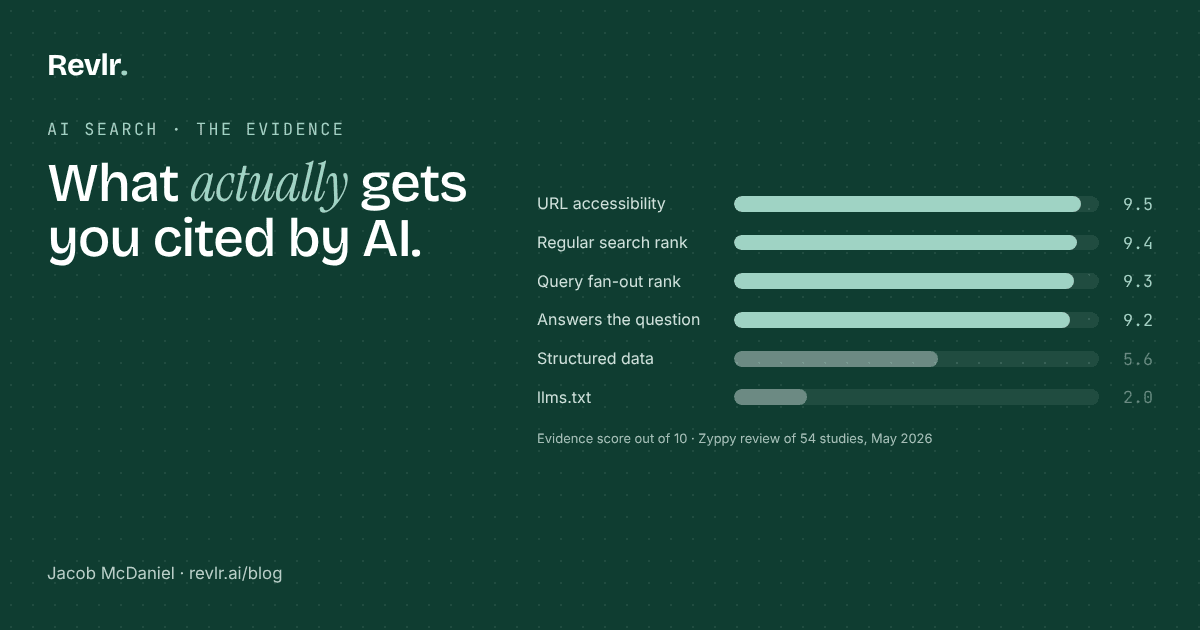
This one sounds too obvious to list, which is exactly why it gets missed. In May 2026, Cyrus Shepard at Zyppy published a review of 54 studies, experiments, and patents on AI citations, scoring 23 factors by the strength of the evidence behind them. The top factor was URL accessibility, at 9.5 out of 10: whether the page is crawlable, not blocked, not paywalled, and not throwing errors.
If an AI search tool can't reach your page, nothing else on this list matters. (We wrote a whole post on which AI crawlers to allow, because most sites get this wrong.)
2. Ranking in regular search
The second-strongest factor in that same review: regular search rank, at 9.4. Close behind was "fan-out rank," which is how well you rank for the related searches AI tools run behind the scenes when they answer a question.
This makes sense once you know how AI search works. Tools like ChatGPT search, Perplexity, and Google's AI Overviews usually run live searches, pull a handful of pages, and write an answer citing a few of them. Google says outright that its AI features run on its core search systems.
So no, SEO isn't dead. It's the foundation AI search is built on.
3. Backing up what you say
This is where the original research gets interesting. The paper that coined the term GEO (Generative Engine Optimization), published at KDD 2024 by researchers from Princeton, Georgia Tech, the Allen Institute for AI, and IIT Delhi, tested different ways of rewriting web pages and measured how often each version showed up in AI answers.
The winners: adding quotations from relevant sources, adding statistics, and citing sources. Together, those techniques boosted visibility by up to 40% across their test queries. When the researchers tried the same techniques on Perplexity, a real AI search engine, they measured gains of up to 37%.
The loser: keyword stuffing, which did worse than leaving the page alone.
That's the clearest signal in the research. AI tools reach for content that sounds like it knows something. Specific numbers. Named experts. Linked sources.
4. Answering the actual question
Zyppy's review scored "query-answer match" at 9.2: pages that directly answer the specific way a question is phrased beat pages that are just on the right topic. If someone asks "how much does a bookkeeper cost in Austin," a page that says "$X to $Y a month" in plain words beats a page about "bookkeeping solutions for growing businesses."
What doesn't (or barely does)
llms.txt
This is the one we get asked about most. Google's May 2026 guide on AI features says site owners don't need to create special AI text files like llms.txt to appear in AI Overviews or AI Mode. Zyppy scored it 2.0 out of 10, the lowest of all 23 factors.
Revlr checks whether you have one, because people ask. It doesn't affect your score.
Special "AI schema"
Structured data still helps regular search, and it can help AI tools tell you apart from a company with a similar name. But Zyppy scored it 5.6 out of 10 for AI citations, and noted that an Ahrefs study found no meaningful citation lift from adding it. Google says there's no special schema markup needed for its AI features.
Keep your schema. Just don't expect it to get you cited.
Chunking and AI rewrites
Google's guide also lists content "chunking" and AI-specific rewriting among the things site owners don't need to do. Write for people. Clear headings and short sections help readers, and that's reason enough.
A note of honesty
Two caveats, because this field deserves them.
First, most of this research measures correlation, not cause. A page that ranks well and gets cited might share a third thing, like simply being good.
Second, AI tools disagree with each other a lot. One analysis of hundreds of millions of citations in early 2026 found that only 11% of domains got cited by both ChatGPT and Perplexity. There's no single trick that works everywhere.
What holds up across all of it: be reachable, rank for the questions your customers ask, say specific things, and back them up.
How Revlr scores this
Revlr's GEO score is built on this evidence. It weighs crawler access and snippet settings heavily, rewards specific facts, sources, and quotes, and skips checks that don't apply to you, like location for an online-only business. llms.txt shows up as information only.
See exactly what we check on the AI search check page.
Questions
The strongest evidence points to being crawlable, ranking well in regular search, answering questions directly, and backing claims up with statistics, quotes, and sources.
There's no good evidence it does. Google says it isn't needed for its AI features, and a 2026 review of 54 studies rated it the weakest of 23 factors.
Only a little, if at all. It still helps regular search results, so it's worth keeping, but it isn't a reliable way to get cited by AI.
Yes. Regular search ranking is one of the strongest predictors of getting cited by AI tools, and Google's AI features run on its core search systems.
Sources
- Aggarwal et al., "GEO: Generative Engine Optimization," KDD 2024
- Cyrus Shepard, "AI Citation Ranking Factors," Zyppy, May 2026
- Google Search Central, AI features and your website
- Averi, AI citation tracking across ChatGPT, Perplexity and Claude (2026)
- Cross-platform citation overlap (Averi analysis, via The Marketing Shelf)